

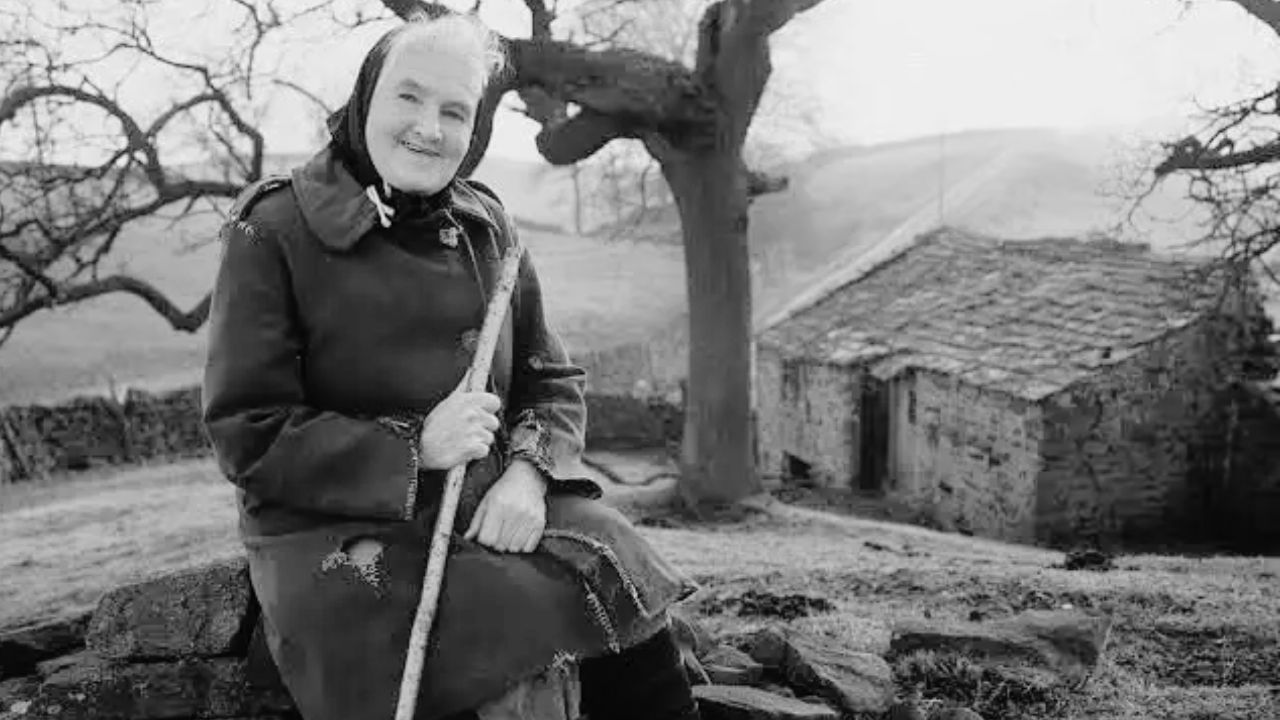
In 1973, around 21 million British television viewers watched a quietly spoken Yorkshire woman carry buckets through snow on a remote moorland farm — and found themselves unable to look away. She wasn’t a politician, a pop star, or an actress. She was a farmer living alone without electricity, on a modest income, in one of the most isolated corners of England.
Her name was Hannah Hauxwell, and her story is one of the most unusual celebrity origin stories in British broadcasting history. This article looks at who she was, where she came from, how she ended up on national television, and why people are still searching for her name today.
Who Was Hannah Hauxwell?
Her full name was Hannah Bayles Tallentire Hauxwell. She was born on 1 August 1926 in Baldersdale, in the North Riding of Yorkshire. She died on 30 January 2018 in West Auckland, County Durham, at the age of 91.
She was the only child of William and Lydia Hauxwell, her mother’s maiden name being Bayles. All of the surnames attached to her — Hauxwell, Bayles, Tallentire — are deeply rooted in the local farming communities of Teesdale and Baldersdale. This is why her name turns up in family trees on genealogy platforms like Ancestry and Geni. Researchers tracing local families in that corner of northern England often encounter her profile.
She was buried at Romaldkirk Cemetery, and her details are recorded on Find A Grave under her full name.
Life at Low Birk Hatt Farm
Low Birk Hatt was a small farm in the Baldersdale valley, set on the Pennine moorlands. It was remote in every sense — far from town, far from neighbours, and far from the kind of modern comforts most people in postwar Britain took for granted.
Hannah grew up there and spent virtually her entire life on that land. After the deaths of her parents and uncle, she took on full responsibility for the farm from around 1961, when she was in her mid-thirties. From that point, she worked the land alone.
Her day-to-day existence was genuinely hard. The farm had no mains electricity. Her income was very modest. Northern winters on the Pennines are long and bitterly cold, and she had limited heating and limited supplies. She tended her cattle, hauled water, and managed everything by herself.
What struck people who encountered her — or later watched her on screen — was that she didn’t complain. Those who met her described her as calm, self-reliant, and unassuming. She wasn’t performing hardship. She was simply living the only life she had known.
Her situation was an extreme version of pressures that affected many small farms in postwar Britain, where rural life was changing rapidly and traditional smallholdings were becoming harder to sustain. But few cases were quite as stark as hers.
The Documentary That Made Her Famous
In 1972 and 1973, Yorkshire Television broadcast a documentary called “Too Long a Winter.” It followed Hannah through her daily routines at Low Birk Hatt — tending animals, moving through snow, managing the land through a harsh winter, largely cut off from the rest of the world.
The programme reached an audience of around 21 million viewers, which is a striking number for a documentary about a single rural woman living quietly on a moorland farm. It made her, as one source later put it, “the twentieth century’s least likely celebrity.”
The public response was immediate and warm. Viewers sent donations and letters. The support she received did improve her living conditions to some degree. People were moved not by drama or scandal, but by the simple contrast between her life and their own — and by the quiet dignity she carried through it.
She had not sought fame. She hadn’t written to a television company or campaigned for attention. A film crew had found her, and what they recorded was enough. The honesty of the portrayal, and the honesty of the subject, did the rest.
Follow-up programmes continued to bring her story to new audiences. A later documentary called “A Winter Too Many” covered the next major chapter of her life — the decision to leave Low Birk Hatt behind.
How She Left the Farm and What Came After
Running a farm alone is physically demanding work at any age. As Hannah grew older, it became impossible to continue as she had. Eventually, she sold Low Birk Hatt and moved to the Copley and West Auckland area of County Durham, where she spent her final years in more comfortable surroundings.
“A Winter Too Many” documents the emotional weight of that transition — leaving a place she had worked and lived on for decades. For many viewers, it was as moving as the original documentary.
She never married and had no children. She had lived alone throughout her adult life, and she remained a private person even as public affection for her story continued to grow. She was often described as shy and genuinely unaware of the scale of her own fame beyond its immediate effects on her life.
She died on 30 January 2018 in West Auckland, aged 91. Her passing was noted across British media, with many commentators reflecting on how much her documentary appearances had meant to viewers across generations.
Hannah’s Meadows: Her Land Lives On
After her departure from Low Birk Hatt and following her death, the land she had farmed became part of a conservation area now known as Hannah’s Meadows, managed by Durham Wildlife Trust.
The site is preserved as traditional species-rich hay meadows — the kind of habitat that has largely disappeared from modern agricultural Britain. The management approach, including late hay cutting and low fertiliser use, reflects the way Hannah herself had farmed, not out of environmental policy, but simply because it was how things had always been done on that land.
Hannah’s Meadows has become a point of interest for those visiting the Teesdale and Baldersdale area, and it keeps her name connected to a living landscape rather than only to television archives.
Why People Still Search for Her Name
Hannah Hauxwell comes up in searches for several different reasons, and it’s worth understanding them separately.
Genealogy researchers encounter her because the Hauxwell, Bayles, and Tallentire surnames are woven into the local history of Teesdale. If you’re tracing ancestors from that part of northern England, her name may appear in your family tree. Geni and Ancestry both carry profiles connected to her, and Find A Grave records her burial at Romaldkirk Cemetery under her full name.
Documentary viewers find her through YouTube uploads of “Too Long a Winter” and “A Winter Too Many,” which continue to introduce her story to younger audiences who weren’t alive when the programmes first aired. The comments on these uploads often reflect genuine emotion — people surprised that they’ve never heard of her before.
Heritage and nature enthusiasts come across her name when exploring Hannah’s Meadows or researching traditional farming landscapes in the Pennines and Teesdale.
And some people simply search for her because a parent or grandparent mentioned watching her documentary decades ago, and they want to understand why that quiet woman on a snowy farm left such a lasting impression.
For those interested in stories of ordinary people who shaped public conversation in unexpected ways, resources like The Business Briefs offer broader context on how public profiles are built and remembered across different fields.
A Story That Holds Up
Hannah Hauxwell’s celebrity was never built on glamour, controversy, or self-promotion. It came entirely from being herself, in front of a camera, on a farm most people would never visit, living a life most people could barely imagine.
She represents an earlier, quieter kind of public figure — one who became known not because she wanted attention, but because her story said something true about a changing Britain and about what it means to live with limited means and unbroken spirit.
More than fifty years after “Too Long a Winter” first aired, people are still finding her story for the first time. That says something about how genuine it was, and how well it was told.
Also Read: